Why OT DataBridge Is the Key to Successful Digital Transformation
The industrial landscape is undergoing a digital revolution. Companies increasingly recognise the value of leveraging data from their Operational Technology (OT) systems to drive informed decisions, improve efficiency, and unlock new business opportunities. Bridging the gap between those OT systems and the IT realm, though, remains a significant challenge for most.
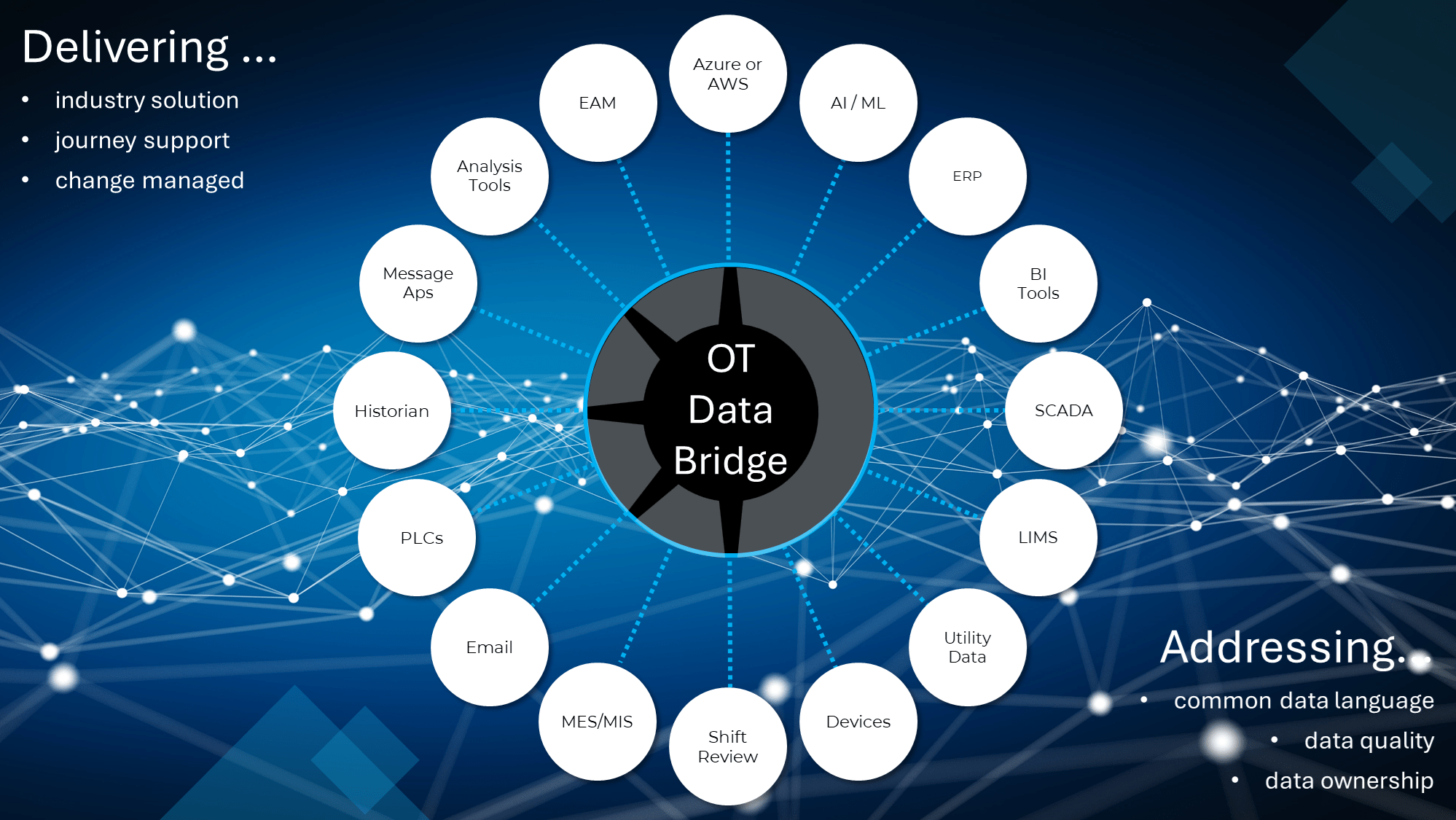
This is where Parasyn's OT DataBridge makes an impact. It acts as a critical bridge, seamlessly integrating industrial data with IT systems, so organisations can unlock the full potential of their digital transformation journey.
Two Problems Stand Between OT and the Business
There are two main problems in bridging the gap with OT systems: language, and data quality.
Think of it like a human conversation. People who don't share a language need an interpreter to communicate effectively, and if you remove vision and hearing from that exchange too, the situation gets harder still. The quality of the interpreter plays a major, pivotal role in the quality of the outcome, a poorly constructed message or a less than functional interpreter leads to miscommunication, inefficiency, errors, and uneven footing.
Where specialised knowledge needs to be shared through technology-based systems, a common understanding, a shared point of reference, and the same conventions throughout, are essential. Organisationally, there's often a real disconnect between asset owners, the business, and operations. Ironically, all three groups want what's best for the organisation, but each carries its own ideals, systems, processes, and tools, and none of them are likely to change given the real constraints they each operate under.
Connecting People, Assets, and the Business
OT DataBridge is built around three connections: people with assets, OT with the business, and demand with operations. And it's built to solve three recurring failure points: low confidence in OT data, weak OT-to-IT integration, and digital projects that simply don't land.
It isn't until the language problem is solved that the quality issues can be tackled and performance lifted. When people have good tools, question what they see, appreciate the potential, and buy into the vision, real change follows. The first focus is communication, establishing excellent communication standards is what creates the platform needed to define and manage out quality issues from there.
Good data has a real cost. Without a clear destination, continuing to create new data sets to meet every request just leads to noise. Data needs to be designed, with automated interpreters used wherever possible. If the easy path of doing things informally continues unchecked, existing data issues will worsen, not improve, as new technology gets layered on without enough consideration. The right combination of technology, process, and mindset solves this, but the data and the technology both need to be properly architected.
Data Silos Hinder Digital Success
Many digital transformation projects fail for one fundamental reason: data silos. Traditional OT systems often operate independently, generating valuable data that stays trapped inside their own infrastructure, never readily accessible to IT systems, and never properly analysed or used. This isn't a new theme, but better tools now in circulation mean there's even more potential to quietly create new problems before anyone notices.
The downside of data silos shows up in a few consistent ways:
- Inefficient operations: without a holistic view of operational and business data together, it's hard to identify bottlenecks, optimise processes, or make genuinely data-driven decisions.
- Limited insights: restricted access to OT data limits the actionable insight available to improve production quality, predictive maintenance, and overall asset performance.
- Missed opportunities: valuable insight stays hidden inside OT data, holding back new business models and services that depend on it.
How OT DataBridge Eliminates the Silos
Parasyn's OT DataBridge offers a comprehensive solution that eliminates these silos and unlocks the real power of OT data:
- Secure and reliable data integration: a secure, robust bridge that integrates disparate OT and IoT systems with IT infrastructure, keeping data flow reliable and consistent.
- Real-time data access: real-time access to operational data, enabling decisions based on the latest information rather than yesterday's export.
- Data normalisation and standardisation: data from varied sources normalised into consistent, usable information for every stakeholder group, with data models defined to match organisational goals.
Benefits of Bridging the OT-IT Divide
Implementing OT DataBridge delivers a range of tangible benefits across the digital transformation journey:
- Improved operational efficiency
- Data-driven decision-making
- Predictive maintenance
- Production quality improvement
- Advanced analytics and reporting
- Innovation and new business models
Why Parasyn? Experience Matters
Parasyn isn't just about technology, it's about understanding the unique challenges industrial organisations face during digital transformation. The team's deep expertise spans both OT and IT systems, which is what allows a genuinely customised solution rather than a generic one. Parasyn works closely with stakeholders and architects to understand current infrastructure, objectives, and challenges, then designs a data bridge implementation model that integrates seamlessly with what's already there. From there, either your team manages the infrastructure, or Parasyn can. The barrier to full ownership is minimal, since the solution is low or no code.
Don't let data silos hold back your digital success. Don't let poor data interpretation stand between high quality data and the people who need it. Get in touch to learn how OT DataBridge can be the key to unlocking what's possible.